Once at a horror convention, I watched a live Q&A with director Joe Dante where the interviewer asked what inspired him to make movies. His answer was unorthodox but unsurprising: Warner Brothers cartoons. In that answer, it explained the slapstick humor and physical gags that permeated his work.
Dante stuck to his roots and followed them to success. He didn’t hide it behind subtlety or disguise it with maturity. He paid homage to his first love and helped it cross over from two-dimensional drawings into the live action genre, and he was completely unapologetic about it.
I feel like writers are constantly being told to find a muse, but their choices can be heavily scrutinized. Scholars will want you to choose the most sophisticated and well-respected role models for your work. It’s just that might not be completely relatable to the author who is looking to be inspired.
What is relatable? For me, it was the storytelling that I was first exposed to. Between picture books and Saturday morning cartoons, I was saturated with drawings, some of which came to life to entertain me, teach me morality tales, and show me how to put a story together with a beginning, middle, and end as well as create interesting characters and have a conflict followed by a resolution. Below is how cartoons became one of my earliest creative inspirations.
My cartoon history

My history with cartoons is that of any kid who was born in the 80s and grew up in the 90s. Cartoons were at the peak of their popularity, and they were primarily available in the mornings, particularly Saturday mornings. I was usually the first person up in the house, and I’d toddle downstairs with my blanket to watch Babar on HBO until Sesame Street came on.
Later, I was the first up to tune into the Saturday morning lineup which included Muppet Babies, Gummy Bears, Beetlejuice, The Real Ghostbusters, Teenage Mutant Ninja Turtles, and Garfield. Later, this evolved into after-school cartoons including Tiny Toon Adventures, Animaniacs, X-Men, Spider-man, Batman, and more. Then, there was Nickelodeon and Cartoon Network which played a mix of both live action and cartoons 24/7. My dad even taped certain episodes of our favorite shows so that we could watch them over and over again.
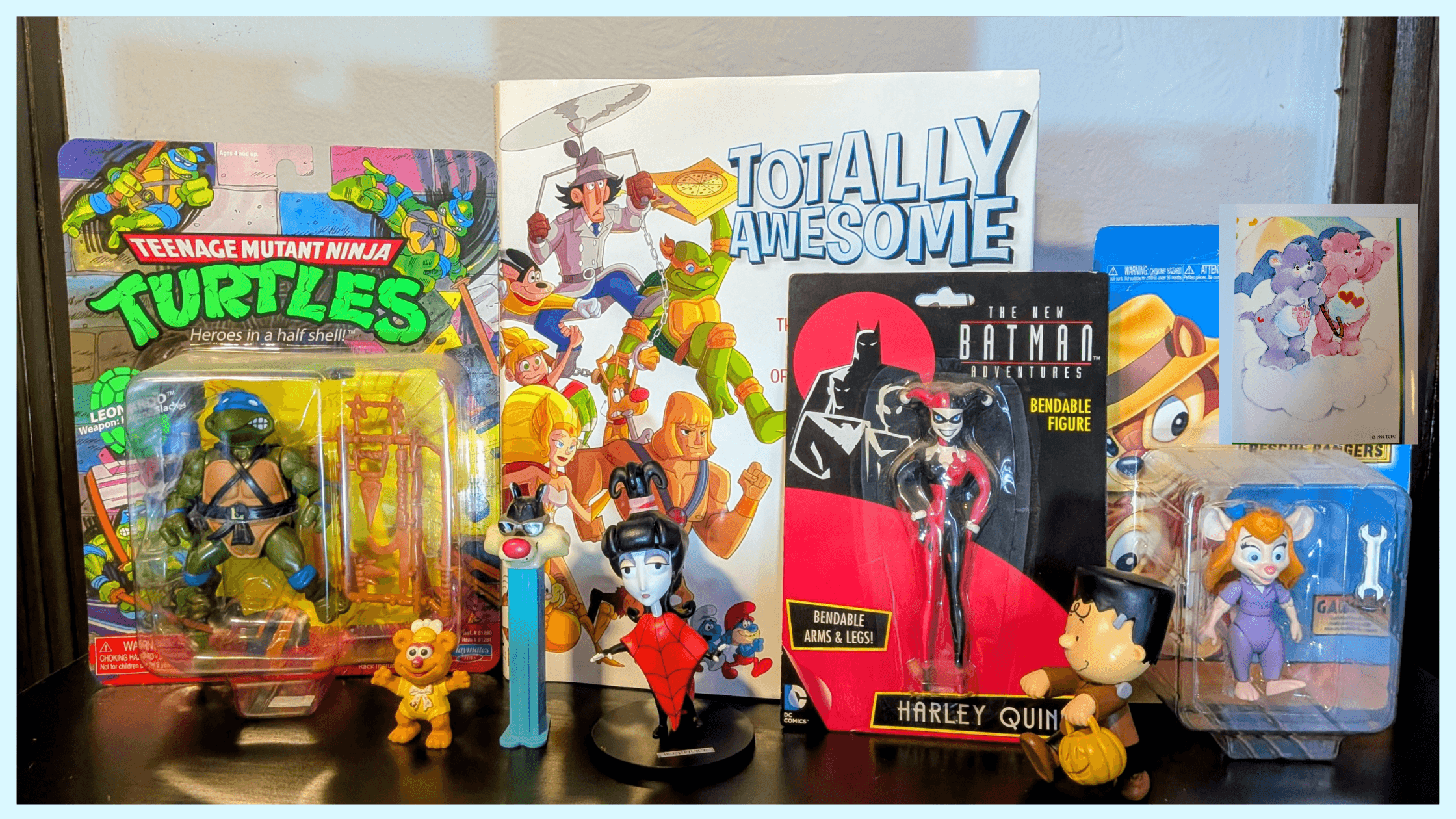
Cartoons were heavily tied into merchandising by then. I remember getting a talking Babs Bunny doll for Christmas one year and my mom once waking me up because our newest box of cereal had come with an action figure of Molly from TaleSpin that I was dying to get.
Because TV came into our homes and we didn’t have to go out for it, we closely connected to the stories, characters, and colorful images that drew us to it. So, when we saw these guys out in the wild, such as in the toy aisle of a department store or on the snack boxes at the grocery store, of course we had to have them.
In this way, cartoons taught me that marketing is the key to selling stories. Kids who don’t read might consider buying the book if it comes with a toy connected to it. When I query my book, I always include my marketing plan and my ideas for merchandising my stories and characters because I know it worked for me.
The sociological side of cartoons

Cartoons are collaborative, both in their creation and representation. Like any stage play, they need a script, and that script consists mainly of dialogue and action.
There’s a cast of characters, typically an ensemble but not always. Sometimes we’re just following one character who might even be silent and who has to tell their story entirely through action and reaction.
Growing up, we had an old Betty Boop tape featuring several episodes of her classic series. In one episode, called “Stop That Noise,” Betty escapes the noisy city to the country and finds just as many noises and distractions in the country setting.
In contrast, I loved tuning into Hey Arnold! and watching the shenanigans of Arnold’s entire neighborhood who attended PS 118 in the city. Their clashing personalities and collaborative nature allowed for an entirely different list of conflicts to resolve.
I especially loved their heat wave episode in which Arnold and Gerald go looking for activities to cool down and can’t seem to find relief until Grandpa loosens the bolts on a fire hydrant and creates a makeshift sprinkler system for the neighborhood. It made you wish you lived in that neighborhood and got to experience both the good and bad that city life had to offer.
The characters of cartoons
Cartoon characters have distinct personalities. From their looks to their attitudes to their reactions to situations, their personalities informed every situation and how they interact within their worlds.
You could love certain characters because they were nothing like you and love them because they were exactly like you. Beetlejuice was a chaotic and energetic character, always getting into trouble and never seeming to learn from his mistakes. On the contrary, Doug Funnie was timid and neurotic, making more out of things than they needed to be and always imagining the worst. He too always learned a lesson that he never quite retained.
Some cartoons were experimental and bizarre. Sesame Street and Pee-Wee’s Playhouse were famous for playing with different mediums to tell little cartoon shorts. They were meant to expand your creativity and think outside the box. Cartoons would shape shift or suddenly switch from reality to fantasy in order to match an image up with an otherwise hard to articulate concept.
The Penny cartoons on Pee-Wee’s Playhouse were stop-motion animation shorts narrated by a little girl who tells relatable adventures about her life. Similarly, the Teeny Little Super Guy shorts on Sesame Street used characters painted on cups which they animated to tell a quick story about a particular topic, such as making friends or making sure you get enough sleep.
Cartoon voices
Cartoons were easy to mimic thanks to the talented voice actors who portrayed our favorite characters. To this day, I still follow some famous voice actors who portrayed some famous animated characters of the 80s and 90s, and it’s fascinating to hear how they came up with the voices and how they actually manipulate their vocal cords, breath, and faces to bring these sounds out.
It’s naïve to think that it’s easy to come up with a new character’s voice. These famous voice actors, such as Jim Cummings, Tara Strong, Rob Paulsen, Tress MacNeille, and more are constantly driving home the point that it’s easy to copy a famous voice. It’s much harder to come up with one from scratch.
When you’re reading, you have to make up all of the voices yourself. Whether you perform them in your head or just read them in a monotone voice is completely up to you. But I feel that watching cartoons made my internal reading voice much more animated and made the characters sound much more distinct in my head. As a result, writing dialogue is much easier for me and much more important, as I want my characters to sound real, authentic, and original.
The heavy storytelling in cartoons
Cartoons can also tackle serious issues. The cartoons I watched growing up weren’t afraid to get sad.
There’s an old Disney short from 1952 called Susie, The Little Blue Coupe. This is one of the cartoons my family had on tape growing up. It was about a little car who is purchased brand new and beloved by her owner until she starts to have mechanical problems. She then endures some hard years on the street through multiple shady owners before being junked, but then she’s restored by a brand new owner and given a new life.
Watching her suffer through the middle of the story was very hard to watch. It didn’t help that my family had a little blue car that ended up meeting the same fate, and it was devastating when we had to get rid of it.
A more popular example that people still talk about online is the Rugrats Mother’s Day episode in which we learn about the death of Chucky’s mom and have to endure him feeling bad because he has no one to celebrate Mother’s Day with. I remember my brother, sister, and I really dissecting that episode after it aired and how bad we felt for Chucky. It was so unfair, but it was reality, and it really struck a chord with us and made us appreciate that our mom was still around.
Cartoon diversity
Cartoon characters were diverse. I don’t just mean that they could be different species of animals or monsters. Nickelodeon cartoons in particular were good about portraying different ethnicities yet making them just as relatable as the others.
I remember being regularly asked to draw or write about my holiday traditions in school, and I would think that everyone celebrated holidays the same way. Cartoons popped that bubble and showed me a more diverse world and not to expect that everyone did everything the same way or had lived the same experiences.
I learned about Hanukkah from Rugrats and watched Mr. Hyunh on Hey Arnold! reunite with his daughter after being separated years ago during the evacuation of South Vietnam. These shows didn’t force feed any certain type of message, not even empathy and respect for others. Instead, you grew a conscience by watching these scenarios play out in two dimensions.
Unorthodox teaching moments in cartoons
Some cartoons, such as those on Sesame Street, are set up to be educational. They introduce you to concepts that you’re eventually going to dive deep into in school. Nerdy kids are drawn to that sort of stuff, and those who aren’t can use those types of cartoons to make it easier to swallow.
However, even those cartoons that were meant purely for entertainment could teach you new words and cultures. I remember a joke on Garfield in which John turned into a disc jockey and how horrified Garfield was of the concept. I had to ask my mom what he was talking about and why he was freaking out about it. The show just laid out the joke and had the kids figure it out or ask for help figuring it out. It inspired conversation and introduced kids to different kinds of humor.
Cartoons also had fun catchphrases that we mimicked and used as a shorthand to communicate in a kind of kid speak that felt like a secret language that wasn’t so secret. It only made sense to shout “Cowabunga” like one of the Teenage Mutant Ninja Turtles before jumping off of something high or getting our friends to laugh by imitating Baby Plucky Duck on Tiny Toons flushing different objects down the toilet.
Creative play
Cartoons informed our make believe play growing up. My friends and I liked a lot of cartoons that were aimed at boys with very few girl characters. So, we would turn those girl characters into main characters and create our own make-believe episodes where we got to be front and center and have the stories revolve around us. Fox Kids should have been studying us for episode ideas for Batman: The Animated Series as we played out storylines featuring Catwoman and Poison Ivy.
We also made up our own games from scratch inspired by our favorite cartoons. Sometimes we’d each choose a big cat to portray and then create scenarios in which we galloped around the African plains as if we were side characters in The Lion King. We gave ourselves superpowers and ran through the neighborhood imagining we were flying, punching imaginary bad guys, and throwing heavy objects. Maybe if we were still doing that, I’d never run out of story ideas.

The backlash
There is truth to the fact that some cartoons were violent or encouraged bad behavior. Kids were always being told that TV would rot their brains. They were afraid that The Simpsons, a show that seems tame compared to the adult cartoons that would follow, would turn us into juvenile delinquents.
I knew kids who weren’t allowed to watch any mainstream cartoons growing up. But guess what? They watched them at our house or learned the jokes from our talks and playground antics at school.
Each show brought something to the table, whether it was a classic Bugs Bunny episode that your grandparents even watched when they were kids, a series based on a successful 80s toy or movie, or an experimental show that you couldn’t even explain to someone without actually watching it with them. Cartoons showed me that story possibilities were endless. Stories could, and should be, fun, and the great ones will endure well after we’ve lost all of our baby teeth.