The insurance industry has undergone a transformation. Insurers came through the challenges presented by COVID-19 remarkably well. The industry met its escalating obligations to policyholders, dealt with unprecedented interruptions to its business, went above and beyond for its customers, and proved its own relevance in a time of extreme crisis.
Now is the time to assess where the industry is heading and what long-term changes are needed to address the macroeconomic fallout from COVID-19; environmental, social and governance (ESG) issues; and workforce-related challenges. Some market players are rethinking their long-term strategies as the notions of trust and societal purpose are playing a greater role in the industry than ever before.
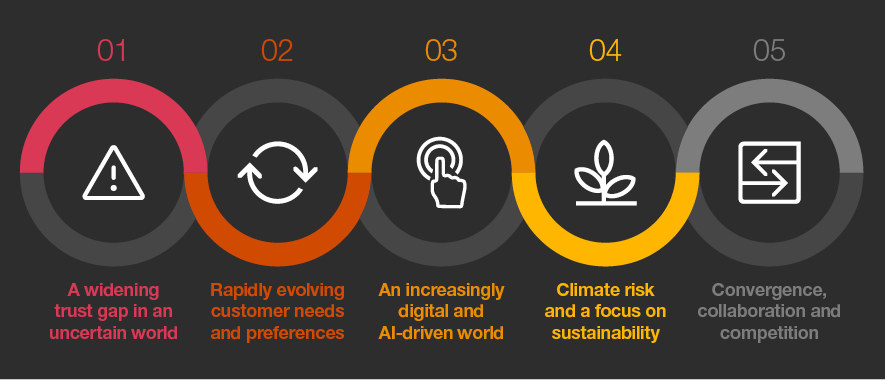
It is against this backdrop, and as a follow-up to our Future of Insurance 2020 report, that we developed our views on insurance in 2026 and beyond. Our findings highlight five trends that will influence the industry and five imperatives insurers need to consider as they rethink their strategies.
It is an exhilarating and challenging time for an industry that is traditionally risk-averse and slow to change. Now, insurers must harness the momentum they’ve gained to reassess the future and reimagine their place in the world.
Five trends affecting the future of insurance
An ambitious agenda must necessarily start with a thorough understanding of the forces that will likely shape insurers’ growth trajectory—over the next five years and beyond.
Adaptive ways to reimagine your business
We have identified five interconnected and mutually reinforcing strategic imperatives for all insurers to consider as they embark on their next phase of growth.
Go on the offensive with digital
Embrace customer-centric ecosystems
Embed ESG in your organisation’s core
Win the race for talent
Put a premium on execution
Go on the offensive with digital
Engage in digital ecosystems.
Build unique customer intelligence.
Build products and services to meet the demands of a digital world.
Disrupt your distribution.
Re-engineer the value chain as a set of digital services.
Adopt a digital mindset.
As expectations evolve and the industry transforms, insurers will need to choose their own path as they contribute to a bold new vision for the industry. Regardless of the path they choose, insurers that anchor their strategy around their social purpose, transform their business model to meet emerging customer needs, and develop an agile, tech-powered organisation will create distinct competitive advantages.
With a spotlight on purpose, trust and transformation, the evolution of the industry in the coming years will be significant for all the players in the insurance ecosystem.
A lot has happened since the start of the year, both at InsTech and across the insurance industry. In this quarterly round-up, we’ve brought together the key topics and themes that defined the first three months of 2025, including those that captured the most attention from our community.
The devastating wildfires in Southern California offered an immediate and scorching reminder of the growing impact of natural disasters in January. This remained a recurring focus, not least as InsTech hosted Exponential Risk London in March, our first dedicated conference for the global catastrophe and climate modelling community.
While exposure management and climate resilience were front of mind, there was also strong engagement with topics shaping the future of insurance: from the practical use of AI in underwriting and claims, to improving data quality, to rethinking how the industry connects both technologically and personally.
Explore the podcasts, articles and insights that mattered most to you, our network, in the first quarter of 2026.
Top podcasts
11,000 of you listened to our podcast this quarter. What tuned your ears?
AI is no longer just a buzzword for insurers. From January to April, the most listened to podcasts made it clear that the insurance industry is actively rethinking how it operates, underwrites and connects with AI.
Insurers have long dealt with legacy systems and manual processes. But from the companies we have spoken to (and you have listened to) this shift isn’t just technical, it’s strategic. What unites these conversations is a shared recognition that data and workflow intelligence are no longer ‘nice to have’.
As the sector looks ahead, whose conversation inspired you the most?
1. How well do you know generative AI?
So how does a major insurer utilise AI? A clear and concise guide to the real-world impact of generative AI in the insurance industry.
2. Designing an intelligent processing platform for insurance
This discussion touches on how AI-powered document ingestion is changing the game for underwriting and claims.
3. Driving underwriting with RiskOps
Federato enables underwriters to triage submissions, prioritise in-appetite risks and streamline workflows using AI-driven insights. Traditional underwriting is evolving, and AI-powered platforms are leading the charge.
4. Connecting brokers, connected insurance
What if brokers could streamline data collection, enhance risk assessment and seamlessly connect with underwriters in real time. Recorder is a company building the next generation of broker management software.
5. 30 minutes to 30 seconds — Serial entrepreneur, survivor and Agentic AI expert
Agentic AI. The buzzword of 2025. But what is it and how can it help claims?
Top articles
From real-time flood prediction to AI-powered data cleansing, the most read articles this year reflect a sector that is moving quickly to understand and address emerging risks. Across the board, insurers are grappling with how to respond to more volatile weather, shifting risk landscapes and growing operational complexity. Discover the five most popular articles so far.
1. Insights into the LA Wildfires and Implications for Insurance
The Los Angeles wildfires served as a sharp reminder of the devastating human and financial cost of climate-driven events, with insured losses potentially exceeding $45 billion. The articles exploring the aftermath highlighted not just the scale of destruction but also the evolving role of models, regulation and resilience in rebuilding efforts. As wildfire risk grows beyond traditional hotspots, the lessons from California are becoming increasingly relevant globally.Click here
2. Who will talk to me? 15 tips for natural networking
One of the most popular articles was on networking: offering simple, practical advice for making real connections in a world where the insurance industry continues to evolve digitally but remains deeply people-driven. It’s a reminder that while technology may be transforming the infrastructure, relationships still sit at the heart of how progress happens.Click here
3. Scrub AI: transforming delegated authority data with AI-driven cleansing
Elsewhere, readers were drawn to practical solutions. Articles on delegated authority data and AI cleansing tools explored how insurers can regain control over inconsistent bordereaux, reduce manual overheads and unlock insights that were previously hidden in poor-quality spreadsheets. The message our community found valuable was clear: better data leads to better decisions.Click here
From budgeting strategies to the impact of Web3, these expert reads cover what really matters this Financial Literacy Month.
In a world of economic uncertainty, digital disruption and growing personal financial responsibility, financial literacy is no longer optional. It’s essential.
To support Financial Literacy Month, we’re highlighting six articles by our authors that help demystify key topics in modern finance. From budgeting and investment mistakes to open banking and the influence of Big Tech, these reads will help sharpen your financial thinking and confidence.
1. How Web3 is Shaping the Future of Finance by Arunkumar Krishnakumar
In the wake of the 2008 financial crisis, the seeds of a new financial era were quietly planted. Just six weeks after Lehman Brothers collapsed, Bitcoin’s whitepaper was released. This article explores how that moment of disruption gave rise to a decentralised financial ecosystem and what it could mean for the future of global finance. Read the article.
2. Inclusive Finance: Unlocking the Power of Open Banking by Ellie Duncan
What if the data you shared with financial services worked for you, not just for Big Tech? This article unpacks how open banking allows consumers to control their financial data and benefit directly from its use. It signals a move toward a more equitable and transparent financial system. Read the article.
3. The Dangers of Big Tech’s Interest in Your Financial Data by Igor Pejic
We’re all increasingly aware of how our data is used, but financial data introduces new and serious risks. This piece highlights the growing concern around Big Tech’s ability to combine financial behaviour with broader data sets. It raises important questions about privacy, surveillance and control. Read the article.
4. Four Ways to Improve Your Business Budgeting by Matt Bamber and Simon Parry
While some call for abandoning traditional budgeting altogether, this article offers a more practical approach: improve it. By integrating strategic planning, business intelligence and flexible models like rolling or zero-based budgets, organizations can transform their budgeting processes for better agility and alignment. Read the article.
5. 10 Reasons Why Your Investments Might Fail by Matthew Partridge
Success in investing often comes from avoiding common missteps. Drawing on real-world experience, this article outlines ten key reasons why investments fail. From emotional decision-making to poor diversification, it shows how to steer clear of the most frequent pitfalls. Read the article.
6. The Importance of Business Budgets: An Overview by David Horner
Budgeting can look very different depending on the size and structure of a business. This article offers a concise overview of why budgeting matters. It’s not just about controlling costs, but about forecasting, improving decision-making and ensuring resource allocation reflects organisational priorities. Read the article.
Ready to go deeper?
If you’re looking to expand your knowledge beyond articles, explore our expert-led books on accounting, finance and banking. From foundational finance to fintech innovation, they’re written by industry leaders and designed to help you make smarter decisions.
The world of finance is evolving rapidly, and businesses must stay ahead of key trends to remain competitive. From the rise of artificial intelligence in financial management to real-time data analytics and regulatory changes, 2026 is set to bring significant shifts in how businesses handle their finances.
For business owners, CFOs, and finance professionals, staying informed about these developments isn’t just about keeping up—it’s about making smart financial decisions that improve efficiency, reduce risk, and maximize profitability. Here’s a look at the top finance trends that will shape the business world in 2025 and what they mean for your company.
1. AI-Powered Finance Tools Are Becoming Essential
Artificial intelligence (AI) is no longer just a futuristic concept—it’s actively transforming how businesses manage their finances. From automating bookkeeping tasks to predicting cash flow patterns, AI-powered financial tools are helping companies save time, reduce errors, and make more informed decisions.
How AI Is Changing Financial Management:
Automated Bookkeeping & Reconciliation: AI-driven accounting software can process and categorize transactions, reducing the need for manual data entry.
Predictive Cash Flow Analysis: AI algorithms analyze past financial data to forecast revenue and potential cash shortages.
Fraud Detection & Risk Management: AI can flag unusual transaction patterns, helping prevent fraud and unauthorized expenses.
Why This Matters for Your Business:
Companies integrating AI-powered tools can operate more efficiently and reduce costly financial mistakes. Instead of relying on outdated spreadsheets, businesses can use AI-driven insights to anticipate financial challenges and make proactive adjustments.
Next Steps:
If you don’t already use AI-enhanced accounting tools, start exploring options like QuickBooks AI, Xero, or SAP’s AI-powered finance solutions.
Consider implementing AI-based fraud detection software to add an extra layer of security.
2. The Shift to Real-Time Financial Data
Gone are the days of waiting until the end of the month or quarter to review financial reports. In today’s fast-paced business environment, companies need instant access to financial insights to make timely and informed decisions.
Benefits of Real-Time Financial Data:
Improved Cash Flow Management: Businesses can monitor cash inflows and outflows in real time, avoiding shortfalls.
Faster Decision-Making: Leadership teams can react quickly to financial changes, whether adjusting budgets or cutting unnecessary expenses.
Greater Financial Transparency: Real-time financial dashboards allow CEOs, CFOs, and investors to track performance metrics anytime.
Why This Trend Is Growing:
With the rise of cloud-based accounting and financial software, businesses can now integrate banking, payroll, and accounts payable data into a single digital dashboard for real-time insights. This level of financial visibility was once only available to large corporations, but now, even small businesses can access the same advantages.
Next Steps:
If your business still relies on manual reporting, consider switching to a cloud-based financial system like NetSuite, FreshBooks, or Zoho Books.
Evaluate financial dashboards that allow you to track key performance indicators (KPIs) in real time.
3. Increased Focus on Cash Flow Optimization
With ongoing economic uncertainty, businesses are shifting their focus from aggressive growth strategies to cash flow optimization. Instead of chasing top-line revenue, companies prioritize financial stability and ensuring sufficient liquidity to weather market fluctuations.
Key Strategies for Improving Cash Flow in 2026:
Stronger Accounts Receivable Processes: Businesses are tightening payment terms and aggressively following up on overdue invoices.
Optimized Vendor Payment Schedules: Companies are strategically timing payments to vendors to maintain healthy cash reserves.
Greater Use of Cash Flow Forecasting Tools: AI-driven forecasting software helps businesses anticipate future cash flow needs.
Why This Matters:
A business can be profitable on paper but still struggle with cash flow if invoices aren’t collected on time or expenses aren’t properly managed. That’s why cash flow management will remain a top priority in 2026.
Next Steps:
Conduct a cash flow audit to identify areas where you can improve liquidity.
If late payments are an issue, implement automated invoicing and payment reminders.
Use cash flow forecasting software to anticipate financial shortfalls before they happen.
4. Regulatory Changes Are Reshaping Tax Strategy
Tax regulations are constantly evolving, and businesses need to stay informed about new IRS rules, deduction limits, and compliance requirements. In 2025, several key tax changes may impact business finances, including:
What to Watch:
Possible Adjustments to Corporate Tax Rates: Federal and state tax laws may shift, affecting tax liabilities for businesses of all sizes.
Increased IRS Scrutiny on Deductions: The IRS is tightening regulations around business expense deductions, making it essential to keep clear records.
Updates to R&D Tax Credits and Business Incentives: Some tax credits may expand or phase out, impacting businesses that rely on these incentives.
Why This Matters:
Staying compliant with new tax laws ensures businesses avoid costly penalties and maximize deductions. Companies that fail to adapt to tax regulation changes may end up overpaying or facing unexpected liabilities.
Next Steps:
Schedule a quarterly tax strategy meeting with your CPA or tax advisor.
Stay updated on IRS guidelines and review changes to deductible expenses.
If your business qualifies for R&D tax credits, ensure you’re tracking all eligible expenses to claim maximum savings.
5. Embedded Finance Is Changing How Businesses Handle Payments
Embedded finance refers to the integration of financial services directly into non-financial platforms. This allows businesses to streamline payments, financing, and transactions. This trend is revolutionizing how companies manage finances, making transactions smoother and reducing reliance on third-party banks.
How Embedded Finance Is Being Used:
E-commerce platforms now offer built-in financing options for customers.
Businesses use automated bill pay systems to handle vendor payments directly within their ERP systems.
Subscription-based models with automated billing improve cash flow and reduce administrative burdens.
Why This Trend Is Growing:
Customers and businesses alike prefer seamless payment experiences. Instead of processing payments through multiple channels, embedded finance allows transactions to be completed instantly within the same platform.
Next Steps:
Explore embedded payment solutions like Stripe, Square, or PayPal for Business if your business processes frequent transactions.
Consider offering customer financing options directly through your website or sales platform.
Summary
The financial landscape is changing fast, and businesses that stay ahead of emerging trends will have a competitive advantage in 2025. Key trends to watch include:
The widespread adoption of AI-powered finance tools to automate bookkeeping, forecasting, and fraud detection.
The shift to real-time financial data allowing for faster decision-making and improved financial transparency.
A stronger emphasis on cash flow optimization ensures businesses remain financially stable even during economic uncertainty.
Regulatory changes affect tax strategies, making it crucial for businesses to stay compliant and maximize deductions.
The rise of embedded finance which is transforming how businesses handle payments and transactions.
By staying informed and proactively adjusting financial strategies, businesses can confidently navigate 2026’s financial landscape. Now is the time to evaluate your current finance processes, implement AI and automation tools, and ensure compliance with upcoming tax regulations to set your business up for long-term success.
The financial services industry is on the brink of an exciting transformation. As we close the chapter on 2024 and dive into 2026, get ready for a year of bold innovation, green initiatives and game-changing customer solutions that will redefine how we bank, invest and grow wealth.
Banking: Your Financial Co-Pilot
In 2026, banking will feel like having a savvy, tech-smart partner by your side:
PROMOTED
AI-Powered Personalization: Get exactly what you need, when you need it, with predictive insights.
Omnichannel Awesomeness: Whether it’s via your laptop or smartwatch, your banking experience will follow seamlessly.
Embedded Finance: Quick and easy financial tools will be built right into your favorite platforms.
Proactive Monitoring: A financial guide will help keep your money on the right track.
Insurance: Smarter Protection For A Safer Future
Insurance is leveling up with intelligence, fairness and sustainability:
Personalized Premiums: This may include rewards for things like safe driving or healthy living, tailored just for you.
Dynamic Pricing: Real-time tweaks make sure you’re always getting a fair deal.
Climate-Conscious Coverage: More insurance plans will be designed to protect and promote a greener tomorrow.
Usage-Based Options: Pay only for what you use—no fluff, just value.
Wealth Management: Empowering Every Investor
Investing in 2026 is about accessibility and personalization:
Democratized Platforms: Open the door for all—start small, think big.
Artificial Intelligence (AI)-Powered Portfolios: Let algorithms optimize your returns while you focus on what matters.
Sustainable Investing: Align your money with your values for impact-driven growth.
Hyper-Personalized Advice: Your financial journey, your way, with expert support.
Corporate Banking: Turbocharging Business Success
Businesses in 2026 will thrive with cutting-edge solutions:
Integrated Ecosystems: Integration offers smooth financial workflows that power efficient operations.
Real-Time Payments: Global transactions will be fast, secure and hassle-free.
Predictive Analytics: These will help you anticipate funding needs before they arise.
Powering The Transformation
The driving forces behind this evolution:
AI and Automation: These will help bring speed, intelligence and personalization to every interaction.
Generative AI: This tool can be used to craft creative, intuitive financial experiences.
Sustainability: Green values will be integrated into every aspect of finance.
Raising The Bar On Experience And Trust
2025 will be all about creating meaningful customer connections:
Tailored Journeys: Experiences will feel like they were designed just for you.
Upskilled Professionals: An upskilled workforce will be equipped to lead in this era of change.
Rock-Solid Security: Innovation will have safety at its core.
What This Means For Those In Finance
Now is the time to reflect and act to stay ahead in this transformative era.
1. Audit your applications, infrastructure and tools.
Are your current tools keeping up with the demands of a rapidly evolving market? If not, it may be time to upgrade to platforms that offer real-time insights, automation and user-friendly interfaces.
2. Embrace new technologies.
Start exploring innovative solutions like AI-driven insights and predictive analytics. Don’t wait to adopt tools that can optimize your financial decisions, give you a competitive edge and complement human potential.
3. Upskill for the future.
Focus on building digital literacy, understanding emerging technologies and staying ahead of trends. Whether you’re a professional or a consumer, continuous learning will be your greatest asset.
4. Think green.
Sustainability isn’t just a buzzword—it’s a strategy. Evaluate how green finance can play a role in your investments, lending practices or business operations. Prioritize choices that align with a sustainable future.
5. Get personal.
Take advantage of the shift toward hyper-personalization. Whether it’s customized investment advice, tailored insurance policies or banking tools built around your customer’s lifestyle, lean into solutions that make your customer’s financial journey smoother and more aligned with their goals.
This is more than just keeping up; it’s about leading the charge. By taking proactive steps now, you’ll position yourself—and your business—for success in the bold, innovative and sustainable world of 2025 financial services.
The information provided here is not investment, tax or financial advice. You should consult with a licensed professional for advice concerning your specific situation.
Forbes Finance Council is an invitation-only organization for executives in successful accounting, financial planning and wealth management firms. Do I qualify?
Nearly 80% of companies are expecting to increase their overall AI spending in the next fiscal year, with Generative AI (GenAI) expanding its share of overall AI budgets, according to the latest Deloitte USState of Generative AI in the Enterprise survey of C-suite executives. That number is a testament to how clearly organizations see the value of AI and GenAI and understand its benefits.
From enhanced decision-making with advanced AI analytics to improved operational efficiency through AI-driven automation and optimization, these exciting technologies offer the potential to take businesses to new levels of productivity and efficiency. Leveraging AI can even bring faster innovation by improving or developing new products and services as well as drawing on data to drive business insights.
For nearly three-quarters of survey respondents, value from AI and GenAI is being achieved, with their most advanced initiatives meeting or exceeding ROI expectations. Furthermore, businesses have been improving their level of preparedness in the critical area of technology infrastructure, according to the survey, in anticipation of scaling their GenAI initiatives.
To keep momentum going, it’s important for organizations to understand the practical steps they will need to take to accelerate the deployment of AI and GenAI across the enterprise. By ensuring that their infrastructure preparedness extends to computational capacity and data, organizations can lay the foundation for business innovation and the opportunities it can bring.
Laying the foundation
To scale GenAI—and get the most value—the investment in infrastructure and necessary computing power will likely be critical. In fact, building, configuring, and managing scalable, robust infrastructure is one of the best ways to achieve a return on investment. Upgrading architectures can support the tremendous speed, scale, and agility needed for modern AI applications—with workflows that often need to juggle billions, even trillions of parameters to train models.
To get AI projects off the ground, organizations should thoroughly assess what graphics processing unit infrastructure—the specialized processors that handle visual and mathematical calculations—may be needed to support AI models and how to tailor it for AI workloads. One option is working with a third-party cloud platform provider that can supply the infrastructure resources needed without the upfront investment.
Optimal utilization of computational resources can also be critical to helping ensure AI workloads are processed swiftly and cost-effectively. With some AI models using 100 times more computer power than just a few years ago, tech companies are starting to optimize large language models (LLMs) for more efficient use of power and data. With scalable and reliable cloud resources, optimized resource management, and high-performance data storage, businesses can see an acceleration of AI workload performance and data retrieval times.
When it comes to data, organizations should also enhance and evolve their ability to identify and leverage AI-ready data as well as their data-handling practices. That is, how they use internal data to train accurate and effective AI models. Organizations may even want to investigate if third-party data will be needed to achieve their AI goals. These efforts should include data security, auditability, and governance—all essential for enterprise AI deployments. Some government entities and enterprises are also increasingly pushing for Sovereign AI—to mitigate risks related to surveillance, cyber threats, and dependence on non-domestic technologies—via increased investment in developing local AI models, building national AI infrastructure, and funding ethical AI initiatives.
Key considerations to scale
To achieve the agility, performance, and speed needed for long-term AI success, organizations should also consider the following even wider-ranging factors:
Compute: As noted above, GPUs are designed to process multiple computations simultaneously and can be clustered for massive scale. Some organizations are looking at ways to optimize utilization given the fact GPUs can be underutilized during peak times.
Networking: AI workloads must be robust to transfer large datasets and to connect compute resources efficiently. This is important to diminish latency that may be magnified by the scale of AI computations and data.
AI data & storage platform: An AI data & storage platform combines AI specialized physical storage with a software platform that drives AI performance scaled to support the velocity, volume, and variety of data that GenAI processes are relying on.
Skill sets: Organizations should look to upskill employees and hire talent with key skills to gain competitive advantage.
Total cost of ownership: The cost of a fully scaled AI infrastructure is significant, varies greatly between archetypes (e.g., public cloud, on premises, private cloud providers), and is evolving rapidly. Another possibility, and perhaps the most effective, is a hybrid AI infrastructure—that is, different archetypes combined for both technical and cost performance.